Understanding how Model Context Protocol (MCP) enables AI applications to connect to external resources and services, extending their capabilities beyond text generation and conversation.
Artificial Intelligence (AI) has advanced rapidly in recent years, and modern Large Language Models (LLMs) are becoming increasingly capable of understanding complex instructions, reasoning through steps, and assisting with general knowledge. However, even a more intelligent AI model remains limited in its ability to interact with the world around it, including external resources.
Think of an AI model as a brain without hands.
No matter how intelligent AI becomes, it remains limited in what it can accomplish without a way to interact with external tools. It may understand how to perform a task, explain the necessary steps, or determine the appropriate action based on the knowledge it has, but understanding alone does not mean it can carry out that action.
Imagine scenarios where you ask an AI assistant to:
- Send an email to a colleague with a project update on command.
- Schedule a meeting based on everyone's availability automatically.
- Book an appointment through an online service on your behalf.
- Search for and retrieve a document, then share it with a team member.
- Automatically update a task's status in a project management application.
This highlights an important limitation in AI adoption. The practical value of AI depends on how effectively it can interact with our existing systems and assist us with them.
Gap Between AI and Existing Applications
Most software applications are designed with the human user in mind. Email applications are used to send emails, calendars are used to organize meetings, booking applications are used to make reservations, and project management software is used to track and update tasks. Each of these applications includes its own user interface (UI), buttons, forms, formats, and workflows for users to perform specific actions. But what if we want an AI assistant to perform those same tasks for us?
Instead of manually navigating multiple applications, imagine simply asking:
Schedule a meeting with the marketing team next Tuesday, send all attendees an invitation, and include the most recent project document, update, and project meeting summary.
To complete this request, an AI-powered application would need to interact with several external systems. An AI model can help interpret requests and determine which actions are necessary, but the external applications must provide the actual connections and tools required to execute those actions, much like an instruction manual for the AI.
Traditionally, software developers have addressed this issue through Application Programming Interfaces (APIs): documented interfaces that let developers build custom integrations. APIs allow applications to interact with existing software without relying solely on human-facing user interfaces (UI).
However, because every application exposes its own API methods, authentication methods, and integration requirements, developers of AI assistants and agents may find themselves repeatedly building similar connections between AI applications and external services.
Several challenges include:
- Duplicated efforts: Similar integrations may need to be implemented multiple times.
- High-maintenance costs: Changes to external services can require updates across multiple applications.
- Limited reusability: A connector developed for one AI application may not work directly with another.
- Slow adoption: Adding new capabilities can require additional custom development.
The key problem is not that an existing API cannot connect these systems. They can, and they remain essential. The challenge is creating a consistent way for different AI applications to discover and use external capabilities.
This raises an important question:
How can we make existing software capabilities accessible to different AI applications without having to reinvent the integration approach each time?
Standardization: MCP
Similar to how internet protocols like TCP provide common standards for system communication, AI applications require a consistent method of interacting with external tools and services.
This is where Model Context Protocol comes in.
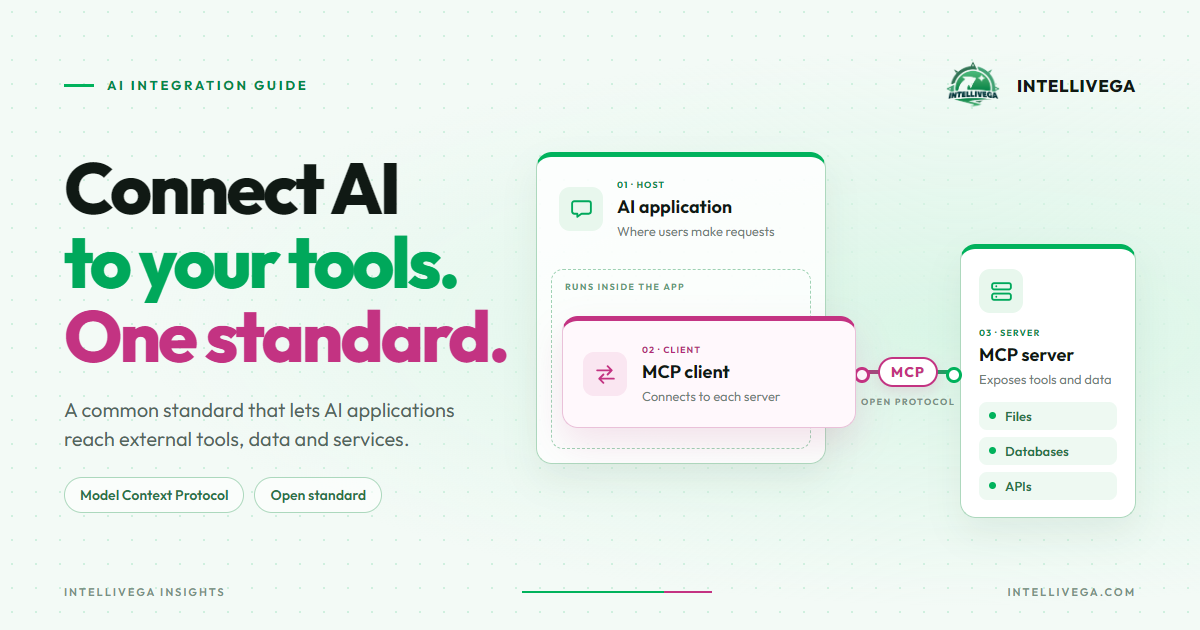
MCP is an open-source standard that defines how AI applications connect to and interact with external tools, data sources, and services. Instead of requiring a completely different integration setup for every application, MCP provides a common way to discover and access available capabilities.
Returning to our earlier analogy, if an AI model serves as the brain and external tools provide the ability to act, MCP defines a standardized method for the AI application to communicate with those tools.
MCP does not replace existing APIs or software. In fact, it works alongside them, allowing existing capabilities to be exposed through a consistent interface that different AI applications can reuse.
How Does MCP Work?
At a high level, MCP connects an AI application to external capabilities through a standardized communication layer. The architecture involves three main components:
- MCP Host: The AI application that users interact with. It manages the AI experience and coordinates access to external capabilities.
- MCP Client: The connector within the host application that communicates with an MCP server using the MCP protocol.
- MCP Server: The component that exposes capabilities from external systems, such as APIs, databases, files, or other services.
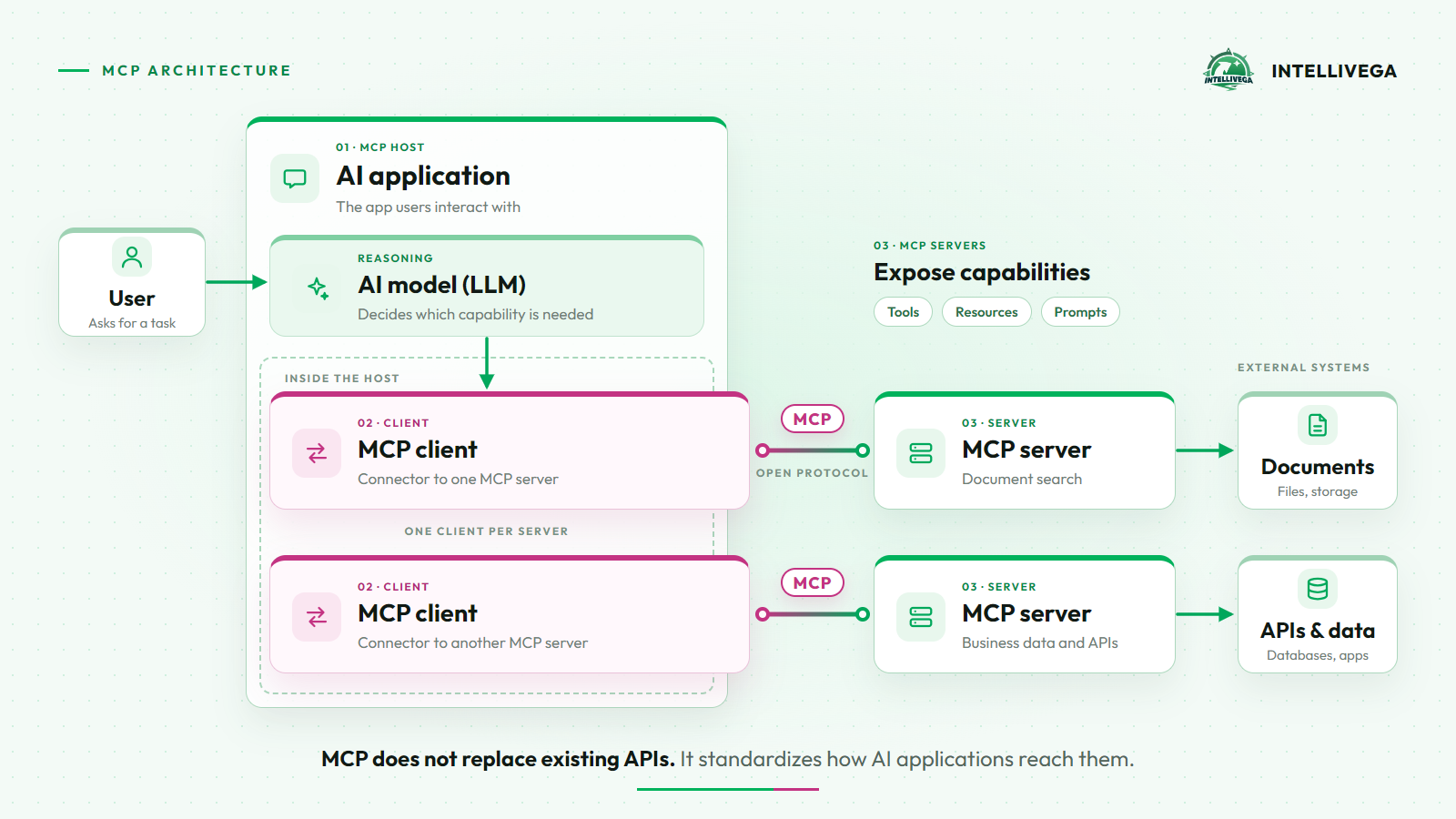
Together, these components allow an AI application to discover what external capabilities are available, request an operation, and receive the result.
A Simple Example
Imagine asking an AI assistant:
Can you find the latest version of this document?
The AI model can understand the request, but it cannot independently access your document storage.
With MCP, the process becomes straightforward:
- The AI application receives the request and determines that document search is needed.
- The MCP client communicates with a connected MCP server that provides a document search capability.
- The MCP server searches the document source using its underlying integration and returns the results.
- The AI application uses the returned information to generate a response for the user.
The AI model handles understanding and reasoning, while the application coordinates tool access. MCP provides the standardized communication between the application and the external capability.
What Can an MCP Server Provide?
MCP supports three primary types of capabilities:
- Tools: Actions that an AI application can request, such as searching documents, creating tasks, or updating records.
- Resources: Information that can be retrieved and provided as context, such as files, database content, or API documentation.
- Prompts: Reusable templates for AI interactions and workflows that an application can offer to users.
These capabilities form the foundation of MCP integration. To understand how they are made available to an AI model, we can look more closely at the three architectural layers: the MCP host, the MCP client connector, and the MCP server.
Where Does MCP Fit in an AI Application?
One common misconception is that MCP replaces traditional APIs.
It does not.
APIs remain the underlying interfaces through which many software systems communicate. MCP provides a standardized layer through which compatible AI applications can discover and interact with capabilities that APIs expose. For instance, an MCP server can expose a tool that internally calls an existing REST API. The business application continues operating as before, while the MCP server provides an AI-compatible interface for selected functionality.
This separation can make integrations much easier to reuse and maintain, particularly when multiple AI applications need similar capabilities. It is also important to understand what MCP is not meant to do.
MCP is not an AI model, and it does not make an AI system more intelligent by itself. It is also not an AI agent framework that decides how complex tasks should be planned or executed.
Instead, MCP addresses a specific part of AI application architecture: how external capabilities are made available and accessed through a standard interface. The AI application still needs appropriate model capabilities, application logic, permissions, and safeguards to use those connections safely and effectively.
Why MCP Matters
As AI becomes more deeply integrated into business software, the challenge is no longer only about what an AI model can understand. It is also about what the application can safely and reliably access and accomplish.
MCP offers a way to reduce some of the integration complexity involved in connecting AI applications to existing internal and external systems.
By providing a common way to connect AI applications with external capabilities, MCP makes integrations easier to reuse and extend. Developers can focus on building useful functionality rather than creating a different communication interface for every AI application.
However, MCP is not necessary for every project. A simple application with a small number of fixed integrations may work perfectly well with conventional API calls. The value of MCP becomes more apparent when applications need to work with multiple external capabilities, when integrations need to be reused, or when systems must evolve over time.
Three Things to Remember
- MCP is a standard method, not an AI model. It defines how AI applications connect to external tools and data sources.
- MCP provides a consistent way to integrate external capabilities. It allows different AI applications to access the tools and data sources through a shared protocol, reducing the redundancy of separate integrations.
- MCP works alongside existing systems. It does not replace APIs, business logic, or security controls. It provides another layer for connecting those capabilities to AI applications.
What's Next?
Understanding conception around MCP is the first step. In the next article, we'll compare MCP integration with traditional APIs, exploring how each method is used in practices, which approach suits best for which situations, and the trade-offs developers should consider when choosing between the two.
At Intellivega, we develop software and AI-integrated applications that connect technology with practical business needs. Whether through conventional APIs or MCP integrations, our focus is on building customized solutions that are reliable, maintainable, and designed around the systems that goal-driven businesses depend on.
References: